Planning a Calligraphy Bar for Your Next Activation? Here's What Actually Goes Into It
Planning a calligraphy bar for your next brand activation or product launch? Here's what a professional event calligrapher actually needs — from table setup and lighting to backup supplies and signage — and why hiring a pro is worth it.
LIVE EVENT ARTISTRY
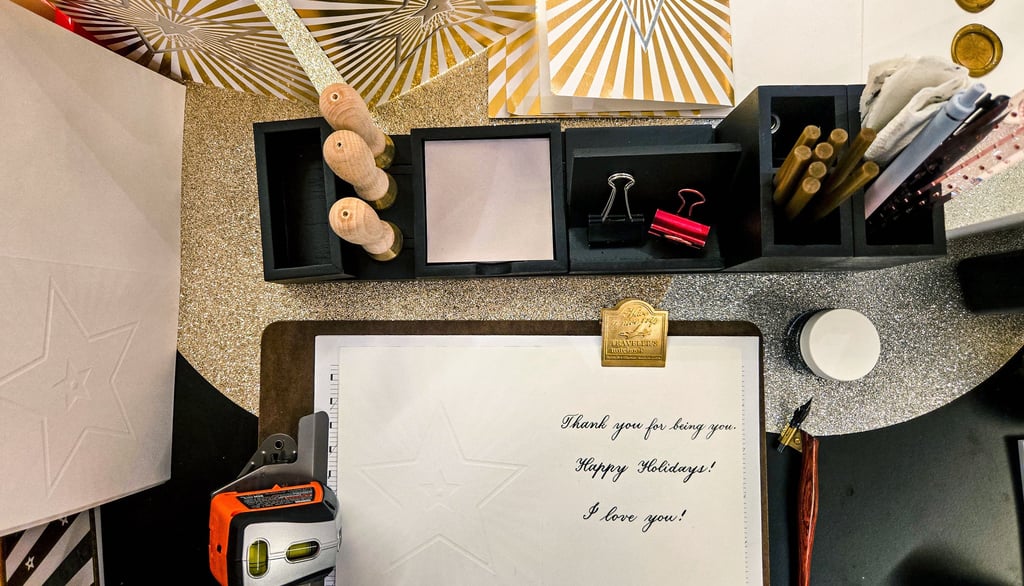
If you're searching "what supplies do I need for a calligraphy bar," chances are you're picturing something straightforward: a pen, some paper, maybe a nice tablecloth. Done.
I get why. From the outside, a calligraphy bar looks like one of the simplest activations you could add to an event. No screens, no staffing logistics, no complicated build. Just a person, a pen, and a line of guests waiting to get their name written beautifully on a card, a bottle, or a product box.
But after working brand activations, product launches, and pop-ups as a calligrapher and event artist, I can tell you the simplicity is mostly an illusion — and it's exactly why so many planners end up either underestimating what the station needs, or deciding to hire a professional instead of trying to put one together themselves.
This post isn't a shopping list. It's what I wish every planner knew before they finalize a venue, a layout, or a vendor brief — so the activation feels elevated instead of chaotic, and so you know what to actually ask the artist you're considering.
The Setup Most Planners Don't Think About
The supplies that matter most for a calligraphy bar aren't the pens. They're the environmental conditions that determine whether the artist can actually do the work well — and most of these get decided weeks before any artist shows up, when the venue and floor plan are being finalized.
Lighting
This is the one that catches planners off guard the most. A lot of brand activations go for moody, ambient lighting because it photographs beautifully and sets the right mood. It's also terrible for fine handwriting. If your venue has low or dramatic lighting, your artist needs their own light source — otherwise you're asking someone to do detailed work in the dark, and the quality will show it.
A sturdy table at the right height
This sounds almost too obvious to mention, but unstable or oddly sized tables are one of the most common problems I run into on-site. The ideal table is at least 36 inches long and 20 inches wide, at a height around 30 inches — essentially, a table you could comfortably write at without slouching. If the artist has to hunch over or steady the table with their other hand, it directly affects the quality of the line work.
A proper chair.
This one's easy to overlook because it seems like a comfort issue rather than a quality issue, but it's both. Calligraphy and personalization work involves a lot of small, controlled hand movements, and that's much harder to do well while standing for hours. A seated artist at the right table height produces more consistent, higher-quality work over a multi-hour event.
Power access, if hot foiling is involved.
Hot foil stamping needs a nearby outlet. If the layout doesn't allow for one near the station, you'll need an extension cord on-site, or your artist will need to know in advance so they can bring one — or, for outdoor events, arrange a portable power station. This is a logistics question worth raising with your artist before the floor plan is locked in.
Placement and airflow, depending on the service.
Engraving stations should be positioned away from heavy guest traffic, since the process produces fine dust and glass fragments that guests shouldn't be breathing in. Painting stations need good ventilation so pieces dry faster — and a portable fan can help here too. If guests are picking up personalized items later rather than taking them immediately, you'll also want a designated staging area for finished pieces.
None of this is complicated once you know to plan for it. The problem is that most planners don't know to ask — and most of these issues only become visible once the artist is already on-site and trying to work around them.
Signage: The Detail That Makes or Breaks Guest Flow
Once the physical setup is sorted, there's one more element that rarely gets enough attention in the planning stage: signage. A calligraphy bar without clear signage creates confusion — guests don't know what they can get personalized, how to join the queue, or what their options are. That confusion translates directly into a slower line, a stressed artist, and a less memorable guest experience.
Good signage does several things at once. It communicates what the station is offering — whether that's hot foiling, pen calligraphy, engraving, or painting — and shows guests how their item can actually be personalized. It also sets expectations upfront: what style options are available (block lettering or script, for example), any word or character limits, and how the process works from start to finish.
That last point is especially important if your activation has a specific guest flow. Are guests lining up and waiting while the artist works? Or are they filling out a form with their personalization request, going off to enjoy the cocktail hour, and coming back to a staging area to collect their finished piece? Both models work well — but guests need to know which one they're participating in, ideally the moment they approach the station, not after they've already been standing in the wrong spot for five minutes.
One practical rule: signage should be legible from at least six feet away. At a brand event with ambient noise, movement, and a lot of visual stimulation, guests are scanning from a distance before they decide to commit to the line. If they can't quickly read what the station is about and how it works from where they're standing, many of them will just move on — and that's a missed opportunity for both the brand and the guest.
Signage is something your calligrapher or event artist can often help you think through, since they know from experience what information guests consistently ask about. But it's worth raising early in the planning process, so it can be designed to match the rest of your event's aesthetic rather than thrown together as an afterthought.
A Real Example: When the Table Wasn't Sturdy Enough
I always ask organizers about these specifics ahead of time, because it's the difference between an activation that feels elevated and one that feels chaotic. I'll ask about table availability, outlet proximity, and lighting conditions specifically — and even when an organizer confirms there's an outlet nearby, I still bring my own extension cord just in case. I'd rather be over-prepared than stuck.
Lighting is the same. For events with moody lighting, I bring a portable lamp every time, because I'm not going to do detailed personalization work in the dark.
Tables are where I've actually run into trouble more than once. I've had two events with wobbly tables. One was manageable — I adjusted where I distributed my weight and worked around it. The other wasn't. No matter how I tried to compensate, the table genuinely wasn't stable enough to write on. I asked the venue manager if we could swap it out, and he was accommodating and got me a sturdier one right away.
That's really the point: even when something does go wrong, an experienced artist knows how to assess it, advocate for a fix, and keep the line moving — rather than letting it derail the guest experience.
What a Professional Brings That You Don't See Coming
The supplies a planner sees on the table are only part of the picture. What actually keeps a calligraphy bar running smoothly is everything brought along in case something doesn't go as planned. This is the part that's hardest to replicate with a DIY setup, because it comes from experience, not a supply list.
For hot foiling — currently my most requested service — I bring the full foil roll rather than pre-cut pieces. Even with guidance to keep word choices short, there's always someone who wants their full name foiled, and I'd rather accommodate that (even if it takes longer than the usual two to three minutes) than turn a guest away. I also bring backups for when foil simply won't adhere to a surface: first, alcohol to clean off any sealant that might be blocking adhesion, and if that doesn't work, gold and silver permanent markers that achieve a similarly luxurious metallic finish.
For pen calligraphy, I bring three types of tools — a pointed pen with ink, brush pens, and permanent markers — because not every surface responds the same way, and I need a backup if one doesn't perform well on the material provided.
For engraving, I bring a full set of burrs in two sizes, since they dull at different rates depending on what's being engraved.
None of this is excessive. It's what experience teaches you to expect, because something unexpected almost always comes up — a longer name, a sealed surface, a denser material. The goal is that guests never see any of this happen. They just see a smooth, professional result.
Why This All Points to Hiring a Professional, Not DIY-ing It
Here's the honest takeaway: a calligraphy bar is one of the easiest activations to underestimate. It looks like a pen and a table. In practice, it's environmental setup, material science, and real-time problem-solving, all happening in front of your guests in real time.
The supplies matter, but they're only half of it. The other half is knowing what can go wrong and having a plan for it before it happens — which surface might reject the foil, which table might need adjusting, which lighting setup will quietly sabotage the line quality. That judgment is built through doing this work repeatedly, not through a list of materials.
So if you're planning a brand activation, pop-up, or product launch and weighing whether to put something together in-house or bring in an artist: it's worth bringing in a professional, not because the supplies are hard to buy, but because the experience of knowing how to handle what the supplies don't cover is the actual value.
Let's Talk About Your Event
If you're in the early stages of planning a launch, pop-up, or activation and want to think through what a calligraphy or personalization station would actually require for your specific venue and layout, I'm happy to talk it through before you finalize anything. Reach out by sending an inquiry here or sending an email to hello@handwrittenbybelle.com.
© 2026. All artwork copyright by Handwritten by Belle.
Handwritten by Belle is an NYC calligrapher & live event artist serving New York, New Jersey & nationwide events. Services include calligraphy, engraving, hot foiling, bottle painting, and watercolor illustration. Please inquire to book for live events such as brand activations, product launches, corporate events, conferences, PR & influencer gifting, weddings, and so much more.