Mindful Calligraphy: How Slowing Down with Ink Can Be Healing
Discover how mindful calligraphy can reduce stress, improve focus, and reconnect you with creativity. Learn beginner calligraphy with Belle’s upcoming workshop.
MINDFUL CALLIGRAPHY
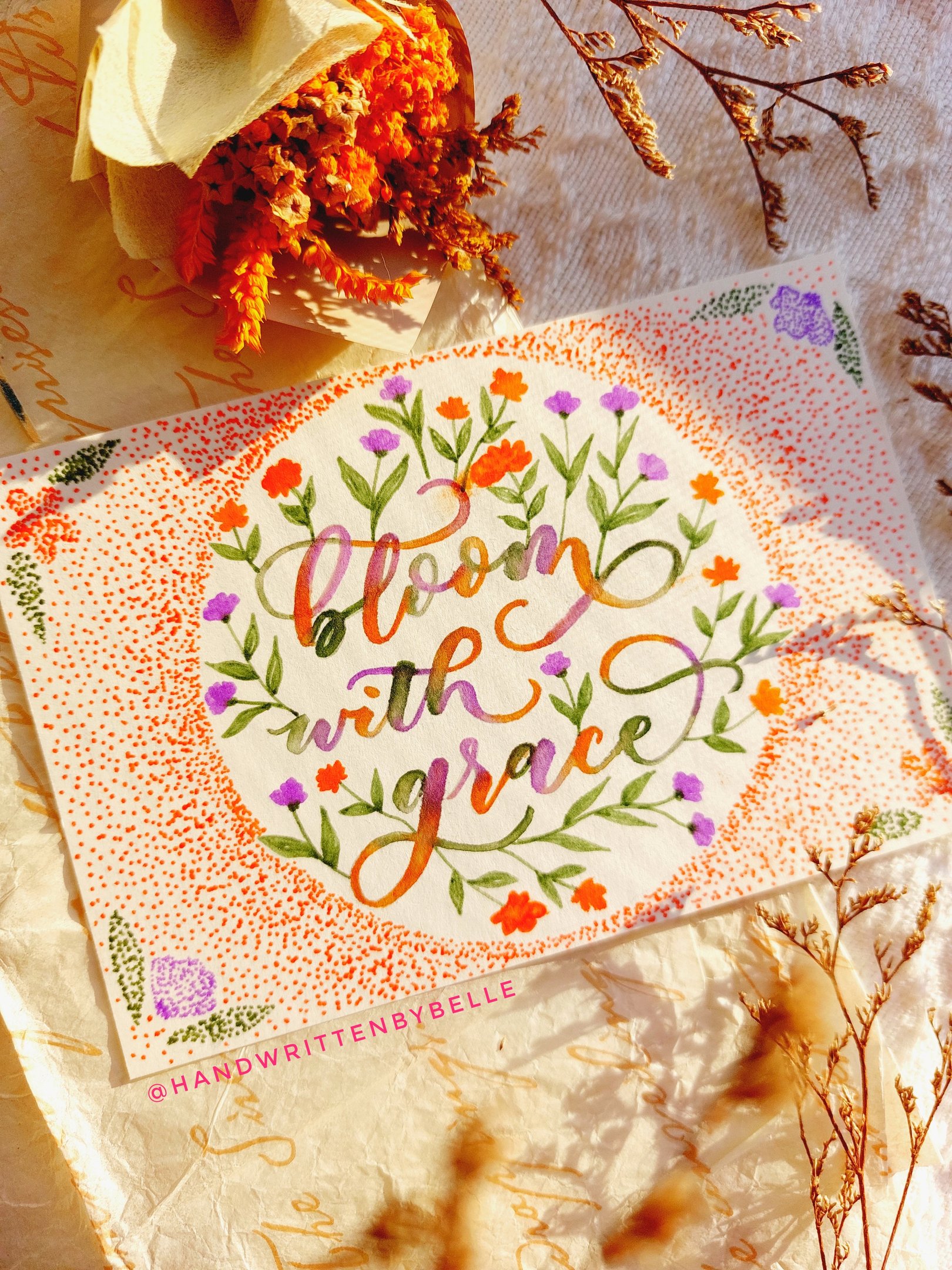
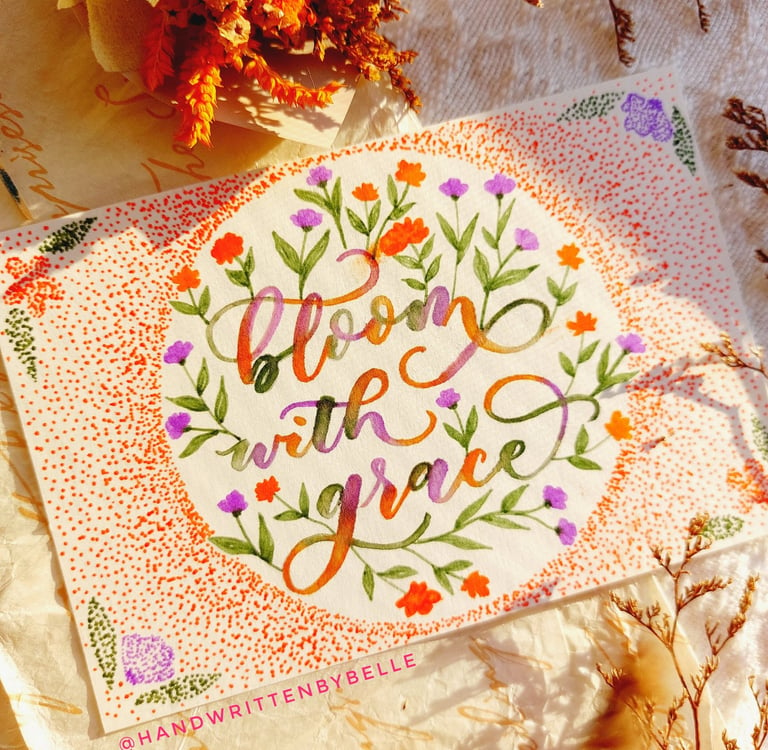
In a world obsessed with productivity and multitasking, resting can feel like a luxury, and slowing down can feel like a weakness. But what if creating and connecting a few strokes using ink could give you a respite? What if your pen became a tool not just for writing, but also for healing?
Welcome to Handwritten by Belle, where calligraphy becomes a healing art. My mission is to promote mindfulness through calligraphy, especially in a world that needs to pause, reflect, and create — without pressure.
If you’ve been wanting to learn calligraphy for beginners, explore a calming hobby, or reconnect with your creativity, this may be the sign you’ve been waiting for.
What Is Mindfulness?
Mindfulness is the practice of being fully present and aware of your situation without judgment.
It is a quiet, safe space where your senses are engaged and your thoughts begin to settle. It is especially helpful when you feel overstimulated because it grounds you back to the present moment.
It is also an ongoing practice. There really is no finish line or “perfect state” of mindfulness.
Calligraphy: How Slow Can You Go?
Calligraphy invites slowness and full presence.
Each stroke is intentionally shaped to create a letter. Your hand moves gracefully, applying and releasing pressure at specific points. Your mind relaxes, and you begin to notice the little things:
the feel of your nib against the paper
the way the brush swells with ink
how your breath mirrors your motion
how shimmer ink reflects the sunlight
As you can see, it is an art that rewards slowness and intention.
Benefits of Mindful Calligraphy
Aside from the finished product of writing pretty letters, there are many reasons why practicing mindful calligraphy can be beneficial for you.
1. Reduce Stress
Calligraphy can have a grounding effect because it allows you to engage your senses.
Like meditation, it gives you a break from the everyday stress of work or school. It creates a small pause in the day where you can simply breathe and create.
2. Enhance Focus and Self-Discipline
When I first started calligraphy, I found it hard to watch shows while practicing because it needed my full attention.
Calligraphy invites you to focus and improve your self-discipline because you need to coordinate your hand with what your eyes are seeing.
Over time, it can lead you into a flow state where intuition guides you instead of conscious effort.
3. Reconnect With Creativity
Creativity can sometimes get lost in a sea of responsibilities and deadlines.
Calligraphy helps you reconnect with your creativity—and maybe even your inner child—because while there are principles to follow, there is still room for your own style and personality through spacing, flourishes, and rhythm.
4. Enjoy Simple, Intentional Moments
When you do what you love simply because you love it, that is pure joy.
No time wasted. No pressure. Just presence.
Whether you are writing a quote, a single word, or your favorite affirmation, every stroke becomes an act of self-care.
Common Beginner Mistakes When Learning Calligraphy
If you are learning calligraphy as a beginner, avoiding these mistakes can save you frustration and help you improve faster.
1. Thinking Calligraphy Is the Same as Handwriting
This is one of the biggest misconceptions.
Calligraphy is not handwriting.
Handwriting is fluid, quick, and functional. Calligraphy is made of intentional shapes and strokes connected together with attention to spacing, height, width, rhythm, and form.
Bad handwriting does not mean you cannot learn calligraphy. As someone who already had pretty good handwriting, it did not automatically help me with calligraphy either.
2. Practicing Letters Right Away Instead of Basic Strokes
Many beginners start practicing letters immediately.
What helped me most was realizing that letters are simply made of basic strokes. When you practice the foundational strokes first, you build consistency that later carries into your letters and words.
I like to think of it this way: You are drawing shapes, not writing letters. Once you understand that, calligraphy becomes much less overwhelming.
3. Practicing on Blank Paper Without Guidelines
Guidelines are so important. I cannot stress this enough.
Use:
grid paper
dotted paper
printed guidesheets
tracing paper used over printed guidesheets
These help you stay consistent with spacing, height, width, and proportions. When your measurements are consistent, your calligraphy instantly looks more polished and professional.
Lined paper may help with height, but it is harder to stay consistent with spacing and width because it only provides horizontal lines.
4. Thinking More Practice Automatically Means Better Calligraphy
More practice does not always mean better results. What matters most is how you practice. Are you practicing intentionally? Are you building the right muscle memory?
If you repeat poor form over and over, you only reinforce habits that hold you back. That is why tracing guidesheets can be so helpful. They train your hand and brain the right way.
It does not matter if you only practiced for a few months. What matters is that you practiced correctly, intentionally, and consistently.
5. Buying Too Many Pens as a Beginner
Another common mistake is thinking you need to buy many pens right away. You do not. I actually recommend starting with just one brush pen while you learn the basics.
I get it though, as a stationery girlie, buying pens is so fun that it can be a little addicting sometimes. But the goal is to remove the overwhelm from your practice.
You don’t want to spend time deciding what to use — the pink one or the black one? The small or the large brush pen? This brand or that brand?
Start with one pen and keep it simple.
Once you begin to see that your strokes are becoming more consistent, that’s the time to explore and try other types of pens.
The most beginner-friendly brush pen, in my opinion, is the Tombow Fudenosuke Hard Tip.
Why I recommend it:
small tip for better control
hard tip that is easier to manage than soft brush pens
does not fray easily
perfect for heavy-handed learners
great for building pressure control and consistency
When you start with one reliable tool, you remove overwhelm and focus on skill-building first.
6. Using the Wrong Tool for the Style You Want to Learn
Different styles of calligraphy require different tools.
For example:
Blackletter or Italic Calligraphy - use broad edge pen or parallel pen for best results
Modern Calligraphy or Copperplate - use pointed pen or brush pen
Using the right tool makes learning much smoother.
Best Paper for Calligraphy Practice
Paper matters more than most beginners realize.
I recommend using smooth paper with at least 120 gsm or 32 lb paper, such as HP Premium Choice LaserJet paper.
This helps prevent:
feathering
bleed-through
rough fibers catching your nib
damage to brush pen tips
Smooth paper makes practice feel easier and more enjoyable. It’s also brush pen friendly! Other recommended paper that I have used include Midori MD paper, Tomoe River paper, and Rhodia pads.
How Long Does It Take to Improve in Calligraphy?
Realistically, if a beginner practices intentionally for even 15-20 minutes a day for 7 days using the right tools and guidesheets, they can already begin seeing progress.
Perfection is not the goal. Progress is.
Think of when you first learned how to type. You may have used one finger at a time and needed to look at every key. Now, you type quickly without thinking.
That is the power of muscle memory.
You do not start from scratch every time you type, and the same applies to calligraphy.
A good tip I learned is to write the date on your guidesheets so you can see how far you’ve come. That little reminder can keep you going.
My Journey With Calligraphy
The time I started learning calligraphy was also the time I felt most burned out at work. I needed a creative outlet that would allow me to reconnect with my artistic self.
At first, I attended a brush calligraphy workshop, but I easily got frustrated because I could not control the brush. I am heavy-handed in writing, so it was hard for me to let go of applying pressure.
But something in me kept returning to calligraphy. Several months have passed, and yet, calligraphy artworks on my Instagram feed still spark joy to me. I followed my intuition, revisited calligraphy, and started a public Instagram account days before my birthday in 2021 to share my calligraphy journey. It turns out that what I dreaded the most – allowing people to see me as a beginner – isn’t so scary after all. If anything, starting from zero and sharing my progress to friends and strangers (who later became online friends), taught me that it is better to learn with a community. It helped me to learn new techniques and believe in myself and the progress that I was making. It helped me see that my struggles are not unique, and that it is okay to make mistakes.
Over time, calligraphy became my sanctuary. It allowed me to play, explore, and discover my artistic style. It also taught me that learning in community makes the journey lighter, more joyful, and less lonely.
In every intentional moment with pen and paper, I found joy. I found community. I found healing.
Why My Mindful Calligraphy Workshop Is Different
Many workshops teach calligraphy as pretty lettering.
I teach it as both a skill and a mindfulness practice.
When I was stressed, calligraphy became a place of respite for me. That is why I designed this workshop to be more than just learning strokes.
Inside Mindful Calligraphy, we will practice:
warm-up drills to relax the arms and hands
breath work (inhale on upstrokes, exhale on downstrokes)
beginner-friendly calligraphy foundations
writing uplifting words and phrases
guided worksheets to continue at home
a final postcard project with a note to yourself
This workshop is a healing and calming creative experience in the form of calligraphy.
My hope is that you leave not only knowing how to do calligraphy — but knowing how to pause, breathe, and create again.
Final Words
Calligraphy is not just about pretty letters. It is about presence.
When we slow down and write with intention, we do not just create art — we create little sparks of joy. And maybe find healing along the way.
FAQs
Can beginners learn calligraphy?
Absolutely. Calligraphy is a learnable skill with the right guidance and consistent practice.
What is the best brush pen for beginners?
I recommend the Tombow Fudenosuke Hard Tip because it is easier to control and beginner-friendly.
Is calligraphy relaxing?
Yes. Many people find calligraphy calming because it encourages focus, breath, and slowness.
How often should I practice calligraphy?
Even 15–30 minutes of intentional practice several times a week can make a difference.
Ready to Try Calligraphy?
If you are feeling overwhelmed or disconnected, I invite you to slow down and write with me.
Start with a single word: breathe.
Take your time. Let each stroke turn into letters. Let it be messy and imperfect. That is where growth begins.
I’m currently creating Mindful Calligraphy, a beginner-friendly workshop where you’ll learn calligraphy in a calm, supportive, and intentional way.
Join the waitlist here to be the first to know when it opens.
If you’re still exploring, you can also read more about the benefits of learning modern calligraphy here.
© 2026. All artwork copyright by Handwritten by Belle.
Handwritten by Belle is an NYC calligrapher & live event artist serving New York, New Jersey & nationwide events. Services include calligraphy, engraving, hot foiling, bottle painting, and watercolor illustration. Please inquire to book for live events such as brand activations, product launches, corporate events, conferences, PR & influencer gifting, weddings, and so much more.